Solar eclipse · 22 July 2028

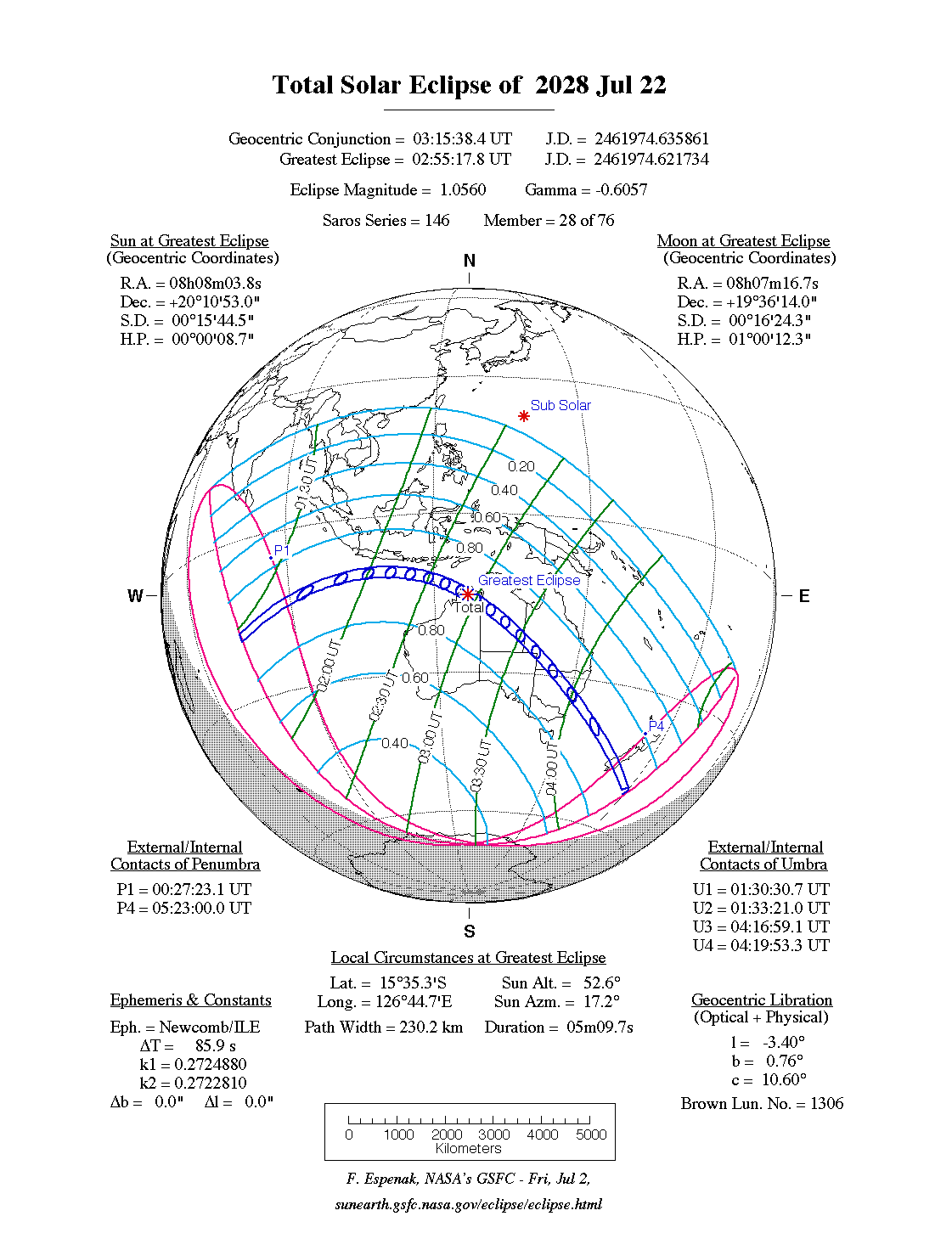
Total solar eclipse of 22 July 2028

In the middle of the Australian winter the Moon’s shadow crosses the continent from the Kimberley in the north-west to Sydney, which sees a total eclipse in the early afternoon. Totality reaches Christmas Island and the Cocos (Keeling) Islands in the Indian Ocean first, then makes landfall in Western Australia and runs south-east across the outback: the Northern Territory, the corner where Queensland meets South Australia, and New South Wales, past Dubbo and Bathurst, to the coast.

After the Tasman Sea the shadow reaches the South Island of New Zealand close to sunset, where Dunedin sees a short totality with the Sun low in the north-west. A partial eclipse is visible across Indonesia, the rest of Australia and much of South-East Asia.

Starts in--until it begins somewhere on Earth

Key facts

Type
Total solar eclipse
Greatest eclipse
02:55:27 UTCat 15.6° S, 126.7° E
Longest totality
5 min 10 son the central line at 15.1° S, 125.8° E
Magnitude
1.0560Moon/Sun diameter ratio at greatest eclipse
Begins (P1)
00:27 UTCfirst contact anywhere on Earth
Ends (P4)
05:23 UTClast contact anywhere on Earth
Visible from
South-East Asia, the Malay Archipelago, Australia and New Zealand
Path of totality
Australia and New Zealand

Saros 146, eclipse 28/76. Computed by our engine from NASA’s Besselian elements: NASA GSFC.

The Moon’s shadow, minute by minute

The band is the path of totality; the lighter area is where the partial eclipse is visible at that moment, and the darkest one is night. Click the map to choose a place.

The Moon’s shadow on the map

Loading the map…

  • Path of totality
  • Centre line
  • Totality now
  • Partial eclipse now
  • Night
  • Chosen place

Chosen place: Sydney. See the times

Your sky during the eclipse

What you will see from Sydney. Move the time slider and watch the Moon slide across the Sun.

The Sun and the Moon

Start12:40End15:14Totality13:59-14:03Up
Close-up, facing the Sun: up is up in your sky. The dashed line is the Moon’s path, from the first bite to the last.

Totality: only now is it safe to look without glasses.

Sun covered:100.0%

Playback slows down around totality.

Where to look

Look north-northwest, 29° up - about a third of the way from the horizon to overhead.

30°WNWNWNNWNNNEStartEnd
The Sun’s path from the start to the end of the eclipse, with a mark every 30 minutes. The small Sun is drawn larger than life.

Your town

Search for any town in the world or use your location to get local times to the second.

Towns and cities of over 15,000 people, worldwide.

Total solar eclipse, 22 July 2028 - Sydney: total, 3 min 48 s of totality

Example

Sydney

New South Wales, Australia

Local time in Sydney (UTC+10)

Sydney is an example in the path of totality. Search for your own town to see your times.

Total eclipse: the Sun is completely covered for 3 min 48 s

Totality lasts
3 min 48 s
Magnitude
1.051
Sun’s area covered
100.0%
Sun at maximum
29° high in the north-northwest
Eclipse times at this place
EventLocal timeUTCSun altitude
Partial eclipse begins12:40:4102:40:4135°
Totality begins13:59:3303:59:3329°
Maximum eclipse14:01:2704:01:2729°
Totality ends14:03:2104:03:2129°
Partial eclipse ends15:14:3905:14:3919°

Times are accurate to a few seconds. Contact times are rounded to the second. How we calculate
Towns in the path

Each town has its own page with local times. Towns in the path come first, ordered by how long totality lasts.

Australia42 towns, 34 with totality

Totality

New Zealand3 towns, 1 with totality

Totality

Partial eclipse

Cambodia1 town

Partial eclipse

Hong Kong SAR China1 town

Partial eclipse

India1 town

Partial eclipse

Indonesia23 towns
Malaysia1 town

Partial eclipse

Maldives1 town

Partial eclipse

Philippines4 towns

Partial eclipse

Singapore1 town

Partial eclipse

Solomon Islands1 town

Partial eclipse

Vietnam3 towns

Partial eclipse

All 82 towns

Watch it safely

Wear eclipse glasses (ISO 12312-2) for every partial phase. Only during totality, while the Sun is completely covered, is it safe to look without them.

How to watch safely

Sources

  1. NASA GSFC - Total solar eclipse of 2028 Jul 22, path table
  2. NASA GSFC - Total solar eclipse of 2028 Jul 22, global map
  3. NASA GSFC - Solar eclipses 2021-2030