Still have a question? The 2027 eclipse overview has the map and the table of towns, the eclipse safety guide covers glasses in detail, where to stay in Spain covers the trip, and our methodology explains how the times are computed.
FAQ
The 2027 solar eclipse, question by question
Short answers to what travellers ask most. For the exact times at your town, use our eclipse tool.
Last reviewed:
When is the total solar eclipse of 2027?
On Monday 2 August 2027. The Moon's shadow first reaches the Atlantic in the morning and leaves the Earth near the Horn of Africa in the afternoon, so the time depends on where you are.
What time is the eclipse?
It depends on the place. In Cádiz, Spain, totality starts at 10:45 local time (CEST); in Luxor, Egypt, at 13:02 (EEST). In London the partial eclipse peaks at 10:00 (BST). Our tool gives every contact time for any town, in local time and UTC.
Where can I see the total eclipse?
NASA lists Morocco, Spain, Algeria, Libya, Egypt, Saudi Arabia, Yemen and Somalia on the path of totality. It also covers Gibraltar and Ceuta, and timeanddate.com shows it crossing eastern Tunisia. The path is only a few hundred kilometres wide, so check your exact town.
How long does totality last?
Up to 6 min 23 s, in Egypt. Luxor gets 6 min 21 s, Tarifa 4 min 39 s and Cádiz 2 min 52 s. Near the edges of the path totality lasts only seconds.
Is it the longest solar eclipse?
It is a long one. With up to 6 min 23 s of totality, it is much longer than the total eclipse of 12 August 2026 in Spain, which NASA itself contrasted with this one. Some travel media call it the "eclipse of the century".
Can I see it from the UK or the US?
From the UK you will see a partial eclipse: in London the Moon covers 42% of the Sun. NASA's region of visibility is Africa, Europe, the Middle East and western and southern Asia, so the eclipse is not visible from the Americas.
Is it safe to look at the eclipse?
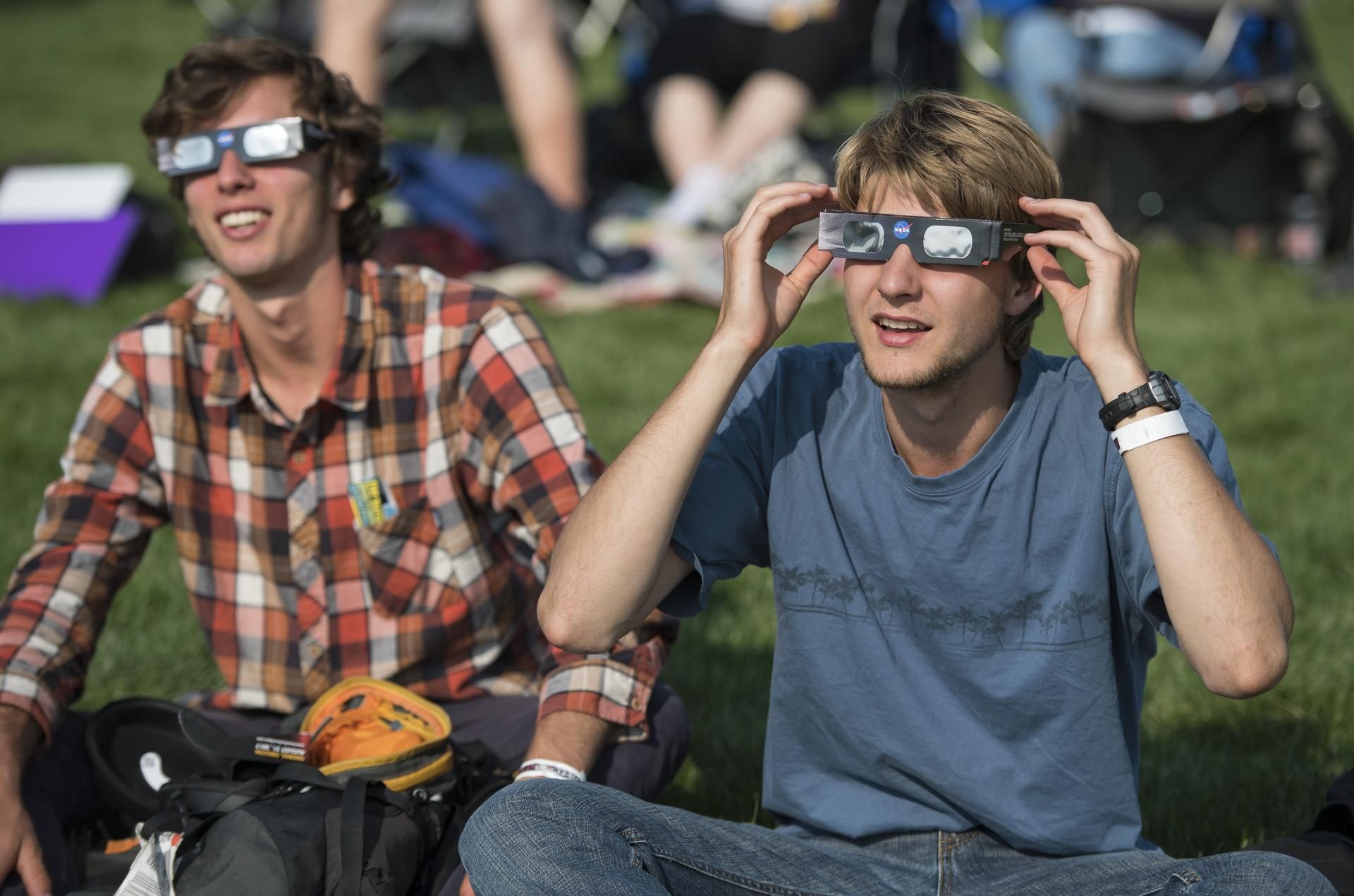
Only through eclipse glasses or a solar viewer that meets ISO 12312-2. The one exception is totality itself, while the Moon completely covers the Sun's bright face. As soon as the bright Sun begins to reappear, put your glasses back on.
Can I use sunglasses?
No. Ordinary sunglasses, however dark, are not safe for looking at the Sun.
Where can I buy eclipse glasses?
From a manufacturer on the American Astronomical Society's list of suppliers, or its authorised dealer. In Spain, Eclipse Seguro reviews the paperwork of glasses sold there. Avoid random marketplace listings, and buy before you travel.
What will the weather be like?
Nobody can forecast a specific day this far ahead, but the climate is favourable. The climatologist Jay Anderson gives Cádiz 88% of early-August days with the Sun visible, and Libya and Egypt are almost cloud-free in summer. In Spain the main risk is a dusty haze.
Why do different websites give slightly different times?
They use slightly different data and assumptions, in particular ΔT (a prediction of the Earth's rotation) and whether the Moon's mountainous edge is modelled. Differences of a few seconds are normal. Our methodology page explains our choices.
Where should I stay in Spain?
Book early with free cancellation, consider sleeping outside the coastal hotspots and driving in early on eclipse day, and follow the traffic authority's advice. Our guide to staying in Spain has the details, plus Gibraltar, Morocco and Egypt.
When is the next solar eclipse after 2027?
On 26 January 2028 an annular ("ring of fire") eclipse crosses Ecuador, Peru, Brazil, Suriname, Spain and Portugal. The next total eclipse follows on 22 July 2028, across Australia and New Zealand.
Sources
- NASA GSFC - Solar eclipses 2021-2030 (dates, central paths, region of visibility)
- NASA GSFC - Path of the total solar eclipse of 2027 Aug 02
- NASA (21 Aug 2026) - NASA shares views of August solar eclipse from ground, air, space
- timeanddate.com - Total solar eclipse on 2 August 2027
- HM Government of Gibraltar (16 Jan 2026) - Planning begins for solar eclipses
- IGN (Spain) - Total solar eclipse of 2 August 2027 (Ceuta, in Spanish)
- Afar (24 Jul 2026) - The "eclipse of the century" will occur in 2027
- AAS - How to view a solar eclipse safely
- AAS - Suppliers of safe solar viewers and filters
- NASA - Eclipse viewing safety
- eclipsophile.com (Jay Anderson) - Weather prospects for 2027 August 2