The rule in one paragraph
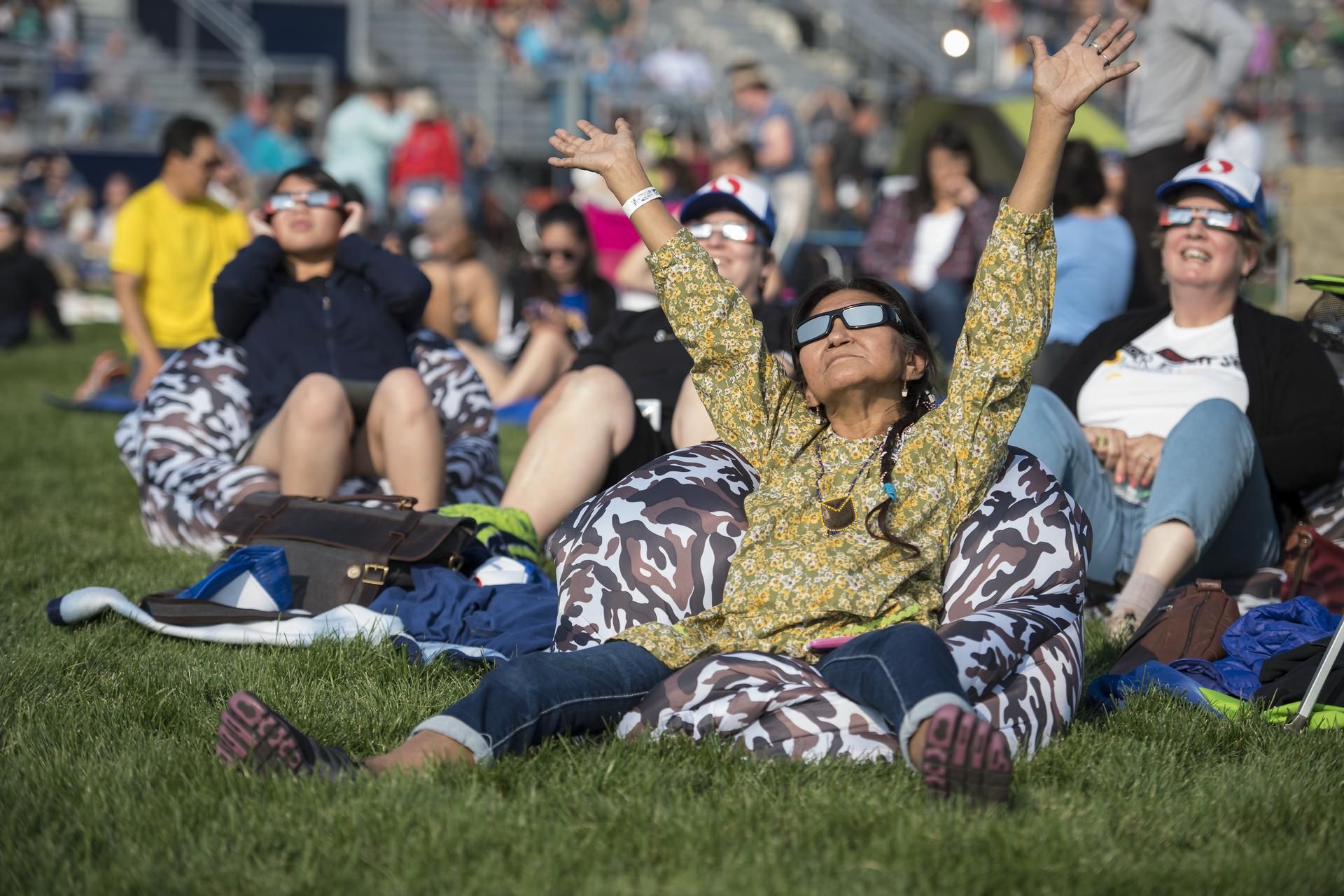
Wear eclipse glasses or a handheld solar viewer that meets the ISO 12312-2 standard for every moment you look at the Sun, from the first bite of the Moon to the last. The single exception is totality: inside the path of totality, while the Moon blocks the Sun’s bright face completely, you may look with bare eyes. As soon as any bright Sun reappears, glasses go back on. Outside the path there is no totality, so the glasses stay on for the whole eclipse.
Ordinary sunglasses are not eclipse glasses. NASA puts it plainly: regular sunglasses, no matter how dark, are not safe for viewing the Sun.
Totality: the one time glasses come off
How long you get depends on where you stand. On the morning of 2 August 2027 totality lasts 2 min 52 s in Cádiz and 4 min 39 s in Tarifa; in the afternoon it lasts 6 min 21 s in Luxor. Our local eclipse times give the exact start and end for any town.
- You will know totality has begun when you see nothing at all through your eclipse glasses. Then take them off and look.
- Do not wait for a timer to tell you it is over. The moment the first bright bead of Sun returns, look away or put your glasses back on.
- Near the edge of the path totality is short, and the exact edge is uncertain by a kilometre or two. Be cautious there, or move towards the centre line.
Are your eclipse glasses safe?
A printed “ISO 12312-2” label proves little: the AAS points out that ISO writes standards but does not test products, and nothing should be sold as “ISO certified”. What matters is who made the viewer. The AAS recommends buying from a manufacturer on its list of suppliers, or from one of that manufacturer’s authorised dealers.
Check your glasses at home before the trip, as the AAS suggests:
- Indoors, put them on and look around. You should see nothing, except perhaps very bright lights, which should look very faint.
- Outdoors on a sunny day, you should still see nothing, except perhaps the Sun’s reflection off a shiny surface.
- Glance at the Sun through them for less than a second. You should see a sharp-edged, round disc, comfortably bright, on a dark background.
Throw away any viewer that is scratched, torn, punctured or coming loose from its frame. NASA adds: inspect them every time before use.
Where to get solar eclipse glasses
Buy them before you travel, not on the morning of the eclipse. During the 2026 eclipse in Spain, the Associated Press reported many pharmacies running out of stock.
- AAS list of manufacturers. The safest route is a manufacturer on the AAS suppliers list, or its authorised dealer. For the United Kingdom the list includes Sollunae (UK sales only).
- Avoid random ads and marketplace listings. The AAS warns against searching the internet and buying whatever pops up in the ads or search results, and lists online marketplaces among the places to avoid.
- Buying in Spain. The AAS points to Eclipse Seguro, run by a volunteer group of Spanish amateur astronomers (OVAE), which reviews the EN ISO 12312-2 paperwork of glasses sold in Spain. It is a documentation review, not a lab test, and the AAS is not involved in it.
Spain’s own record from 2026 shows why this matters: the government’s review found more non-compliant glasses among products sold online and asked for 7 models from 7 brands to be withdrawn.
Cameras, binoculars and telescopes
- Never look through a camera, binoculars or a telescope while wearing eclipse glasses. The concentrated light burns through the glasses’ filter and into your eye.
- Optics need their own solar filter, fitted securely over the front of the lens or telescope, never at the eyepiece end.
No glasses? Use a pinhole
You can watch the partial phases indirectly. Stand with your back to the Sun and let sunlight pass through a small hole, for example one punched in a card, onto paper or the ground. Even the gaps between your crossed fingers will project small crescent Suns. Never look at the Sun through the hole itself.
Children
NASA’s advice is to always supervise children using solar viewers. Make sure the glasses fit and cannot slip, and agree in advance on the signal to put them back on after totality.
If your eyes hurt afterwards
After the 2026 eclipse, Spain’s government review counted 33 hospital visits for eye injuries in the Basque Country alone, most of them mild. Spain’s Ministry of Health recommends going to a hospital with an ophthalmology service if visual symptoms appear after watching an eclipse.
Planning the trip itself? See where to stay for the eclipse in Spain and the eclipse FAQ.