Solar eclipse · 14 November 2031
Hybrid solar eclipse of 14 November 2031
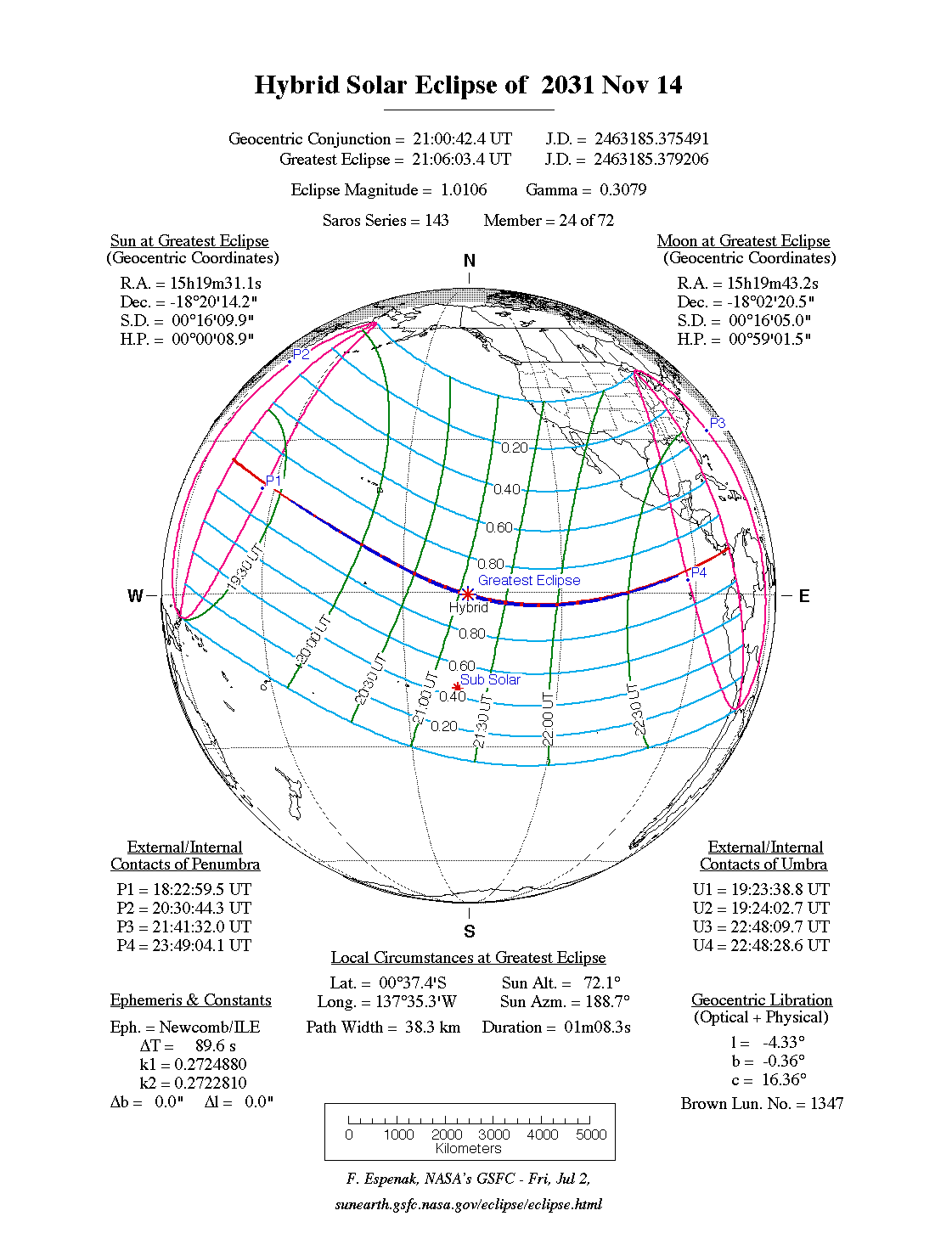
On 14 November 2031 the Moon’s shadow tip only just reaches the Earth: along its path the eclipse is total in some places and annular in others. The central path crosses Panama and the Pacific; a partial eclipse is visible from the Pacific, the southern United States, Central America and north-western South America.
Key facts
- Type
- Hybrid solar eclipse
- Greatest eclipse
- 21:06:12 UTCat 0.6° S, 137.6° W
- Longest central phase
- 1 min 8 son the central line at 1.0° S, 136.5° W
- Magnitude
- 1.0106Moon/Sun diameter ratio at greatest eclipse
- Begins (P1)
- 18:23 UTCfirst contact anywhere on Earth
- Ends (P4)
- 23:49 UTClast contact anywhere on Earth
- Visible from
- The Pacific, the southern United States, Central America and north-western South America
- Central path
- Panama and the Pacific
Saros 143, eclipse 24/72. Computed by our engine from NASA’s Besselian elements: NASA GSFC.
The Moon’s shadow, minute by minute
The band is the path of the central phase; the lighter area is where the partial eclipse is visible at that moment, and the darkest one is night. Click the map to choose a place.
Towns and cities of over 15,000 people, worldwide.
Hybrid solar eclipse, 14 November 2031 - Mexico City: partial, 39.1% of the Sun covered
Mexico City
ExamplePartial eclipse
- Sun covered
- 39.1%
- Maximum
- 16:30:36UTC-6
Loading the map…
Shadow map
Your sky
Sun covered39.1%
Mexico City: partial, 39.1% of the Sun covered
- Central path
- Centre line
- Central phase now
- Partial eclipse now
- Night
- Chosen place
Mexico City · Mexico City, Mexico · Local time in Mexico City (UTC-6)
Mexico City is an example in the path of totality. Search for your own town to see your times.
- Magnitude
- 0.500
- Sun’s area covered
- 39.1%
- Sun at maximum
- 18° high in the west-southwest
| Event | Local time | UTC | Sun altitude |
|---|---|---|---|
| Partial eclipse begins | 15:19:59 | 21:19:59 | 32° |
| Maximum eclipse | 16:30:36 | 22:30:36 | 18° |
| Partial eclipse ends | 17:31:53 | 23:31:53 | 5° |
Times are accurate to a few seconds. Contact times are rounded to the second. How we calculate
Towns in the path
Large towns where the eclipse can be seen. Choose one to see it in the tool above.
| Town | What you see | Maximum (UTC) |
|---|---|---|
| MaracaiboVenezuela | 99% covered | 22:47 |
| BarranquillaColombia | 95% covered | 22:47 |
| BarquisimetoVenezuela | 94% covered | 22:47 |
| ValenciaVenezuela | 92% covered | 22:47 |
| CaracasVenezuela | 92% covered | 22:46 |
| MedellínColombia | 87% covered | 22:49 |
| BogotáColombia | 79% covered | 22:49 |
| CaliColombia | 78% covered | 22:49 |
| Santo DomingoDominican Republic | 73% covered | 22:43 |
| Port-au-PrinceHaiti | 70% covered | 22:43 |
| Santiago de los CaballerosDominican Republic | 69% covered | 22:43 |
| QuitoEcuador | 67% covered | 22:49 |
| GuayaquilEcuador | 61% covered | 22:49 |
| HavanaCuba | 44% covered | 22:39 |
| MéridaMexico | 43% covered | 22:37 |
| PueblaMexico | 41% covered | 22:31 |
| Mexico CityMexico | 39% covered | 22:30 |
| Santiago de QuerétaroMexico | 35% covered | 22:28 |
| León de los AldamaMexico | 32% covered | 22:25 |
| ZapopanMexico | 32% covered | 22:23 |
| LimaPeru | 26% covered | 22:47 |
| MonterreyMexico | 22% covered | 22:23 |
| HoustonUnited States | 16% covered | 22:23 |
| San AntonioUnited States | 15% covered | 22:20 |
Watch it safely
Where this eclipse is annular, a ring of the Sun stays uncovered: keep eclipse glasses (ISO 12312-2) on throughout. Only where it is total, and only during totality, is it safe to look without them.
How to watch safely