Solar eclipse · 30 March 2033

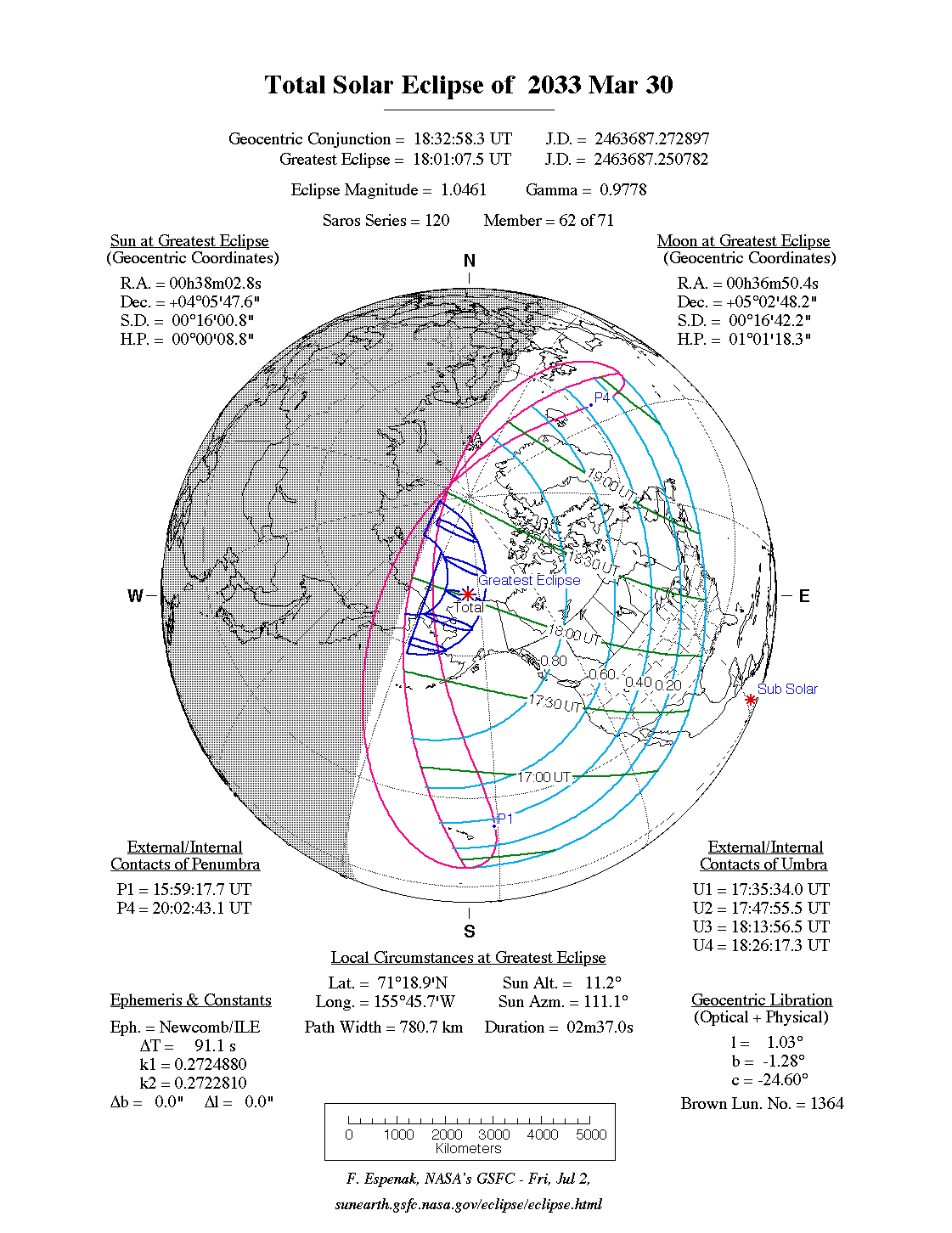
Total solar eclipse of 30 March 2033

On 30 March 2033 the path of totality crosses Russia and Alaska, and a partial eclipse is visible from North America and the far east of Russia. At greatest eclipse, at 18:01 UTC, totality lasts 2 min 37 s on the central line.

Starts in--until it begins somewhere on Earth

Key facts

Type
Total solar eclipse
Greatest eclipse
18:01:16 UTCat 71.3° N, 155.8° W
Longest totality
2 min 37 son the central line at 71.2° N, 155.9° W
Magnitude
1.0462Moon/Sun diameter ratio at greatest eclipse
Begins (P1)
15:59 UTCfirst contact anywhere on Earth
Ends (P4)
20:02 UTClast contact anywhere on Earth
Visible from
North America and the far east of Russia
Path of totality
Russia and Alaska

Saros 120, eclipse 62/71. Computed by our engine from NASA’s Besselian elements: NASA GSFC.

The Moon’s shadow, minute by minute

The band is the path of totality; the lighter area is where the partial eclipse is visible at that moment, and the darkest one is night. Click the map to choose a place.

The Moon’s shadow on the map

Loading the map…

  • Path of totality
  • Centre line
  • Totality now
  • Partial eclipse now
  • Night
  • Chosen place

Chosen place: Anadyr. See the times

Your sky during the eclipse

What you will see from Anadyr. Move the time slider and watch the Moon slide across the Sun.

The Sun and the Moon

Start04:54End06:42Totality05:47-05:47Up
Close-up, facing the Sun: up is up in your sky. The dashed line is the Moon’s path, from the first bite to the last.

Totality: only now is it safe to look without glasses.

Sun covered:100.0%

Playback slows down around totality.

Where to look

Look east, 1° up - low over the horizon.

30°NEENEEESESEStartEnd
The Sun’s path from the start to the end of the eclipse, with a mark every 30 minutes. The small Sun is drawn larger than life.

Your town

Search for any town in the world or use your location to get local times to the second.

Towns and cities of over 15,000 people, worldwide.

Total solar eclipse, 30 March 2033 - Anadyr: total, 49 s of totality

Example

Anadyr

Chukotka, Russia

Local time in Anadyr (UTC+12)

Anadyr is an example in the path of totality. Search for your own town to see your times.

Total eclipse: the Sun is completely covered for 49 s

The eclipse is already under way when the Sun rises here.

Totality lasts
49 s
Magnitude
1.043
Sun’s area covered
100.0%
Sun at maximum
1° high in the east
Eclipse times at this place
EventLocal timeUTCSun altitude
Partial eclipse beginsSun below the horizon04:54:5116:54:51-5°
Totality begins05:47:0817:47:081°
Maximum eclipse05:47:3317:47:331°
Totality ends05:47:5717:47:571°
Partial eclipse ends06:42:2318:42:237°

Times are accurate to a few seconds. Contact times are rounded to the second. How we calculate
Towns in the path

Large towns where the eclipse can be seen. Choose one to see it in the tool above.

Towns where the eclipse of 30 March 2033 is visible, central phase first
TownWhat you seeMaximum (UTC)
AnadyrRussiatotality 49 s17:47
VancouverCanada63% covered17:41
EdmontonCanada61% covered17:58
SeattleUnited States59% covered17:39
CalgaryCanada57% covered17:54
PortlandUnited States55% covered17:35
SacramentoUnited States39% covered17:24
San JoseUnited States37% covered17:22
WinnipegCanada37% covered18:14
FresnoUnited States34% covered17:23
Las VegasUnited States27% covered17:28
Los AngelesUnited States26% covered17:20
GlasgowUnited Kingdom24% covered19:21
DenverUnited States24% covered17:49
TijuanaMexico22% covered17:19
MexicaliMexico20% covered17:21
PhoenixUnited States19% covered17:28
DublinIreland18% covered19:24
AlbuquerqueUnited States16% covered17:39
TucsonUnited States15% covered17:27
MilwaukeeUnited States13% covered18:23

Watch it safely

Wear eclipse glasses (ISO 12312-2) for every partial phase. Only during totality, while the Sun is completely covered, is it safe to look without them.

How to watch safely

Sources

  1. NASA GSFC - Total solar eclipse, 2033-03-30: Besselian elements
  2. NASA GSFC - Total solar eclipse, 2033-03-30: path table
  3. NASA GSFC - Total solar eclipse, 2033-03-30: global map